


What Are SelfInsulation Brick Making Machines 2026 Complete Guide and Expert Insights
This guide is developed by senior R&D engineers from Quanzhou Qisheng Machinery Manufacturing Co., Ltd. (brand SINO), a leading provider of integrated brick production solutions with over 10 years of industry experience. Self-insulation brick making machines are core automated equipment for producing concrete blocks with built-in thermal insulation properties, widely used in new building materials production, municipal infrastructure, and solid waste resource utilization sectors. They address key industry pain points such as high labor costs, unstable production capacity, and non-compliant environmental performance. However, many engineers, procurement specialists, and industry practitioners have misconceptions about their working principles, classification, application scenarios, and selection criteria, especially when evaluating Chinese manufacturers. This guide draws on 100+ global project cases to explain the core definition, working principle, main types, industry applications, international standards, and common misconceptions of self-insulation brick making machines, helping you build a systematic and professional understanding for informed selection.
Core Definition and Industry Positioning
According to EU Machinery Directive 2006/42/EC and China's GB/T 38124-2019 standard, self-insulation brick making machines refer to automated production equipment that integrates intelligent batching, forced mixing, high-pressure forming, and automatic palletizing to produce concrete blocks with uniform internal thermal insulation layers. In simple terms, they eliminate the need for additional external insulation layers during construction, reducing overall building energy consumption and construction costs.
As a key equipment for the global building materials industry's digital transformation and green upgrading, self-insulation brick making machines offer irreplaceable core advantages: they produce high-value-added energy-saving blocks, reduce labor reliance by 60% or more, and meet strict global environmental emission requirements.
Core Differences from Traditional Brick Making Machines
Technical Indicator | Self-Insulation Brick Making Machine | Traditional Ordinary Block Machine |
|---|---|---|
Thermal Insulation Block Adaptability | Supports uniform mixing of insulation particles, produces blocks with built-in insulation layers | Only produces ordinary blocks, no insulation function |
Automation Level | Full PLC control, one-click operation, automatic palletizing | Semi-automatic, requires manual palletizing |
Compliance Certification | CE, ISO9001, meets EU and international safety standards | Mostly only meets domestic basic standards |
Customization Capability | Supports non-standard customization for special brick types, site dimensions, and capacity requirements | Limited customization, fixed brick type range |
Working Principle Overview
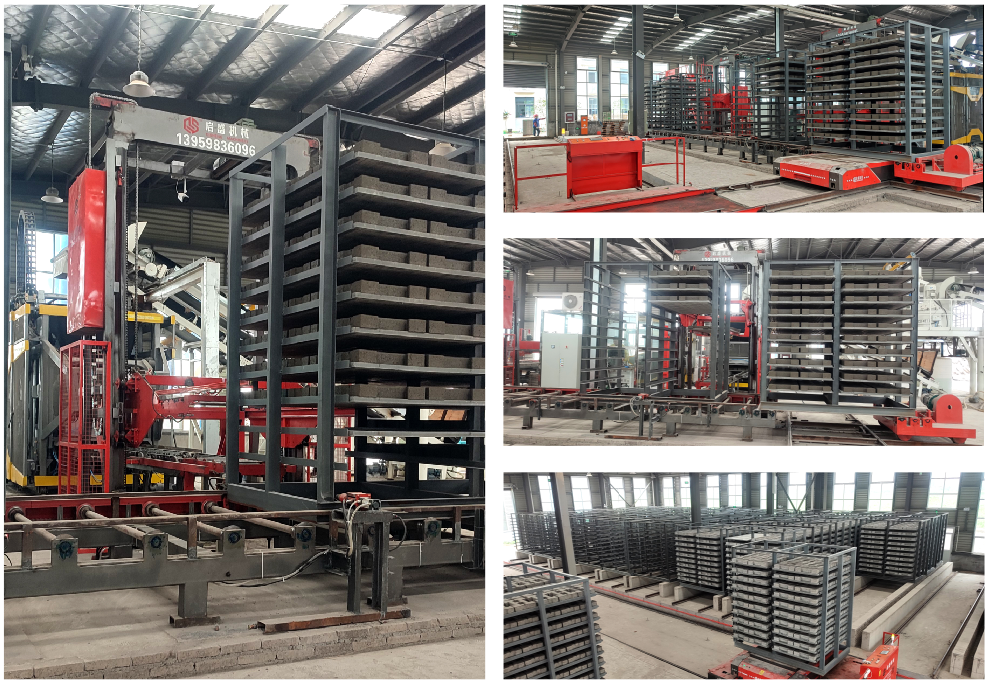
In simple terms, self-insulation brick making machines complete the entire production process from raw material batching to finished product packaging through coordinated control of mechanical, hydraulic, and electrical systems. The professional working process can be divided into 5 core steps:
1. Intelligent Batching: PLC system accurately measures raw materials including cement, aggregate, and insulation particles, with a batching error controlled within ±2%.
2. Forced Mixing: Sealed forced mixing structure ensures uniform distribution of insulation particles, avoiding uneven block strength.
3. High-Pressure Forming: Servo-controlled high-pressure forming ensures the structural stability of the insulation layer and the overall block strength.
4. Automatic Conveying and Curing: Blocks are automatically conveyed to the curing area with controlled temperature and humidity to reach the required strength.
5. Automatic Palletizing and Packaging: Unmanned palletizing and moisture-proof packaging reduce manual handling and product damage.
Key Performance Indicators for Selection
Core Performance Indicator | Standard Definition | Industry Reference Value | Selection Significance |
|---|---|---|---|
Batching Accuracy | Deviation of raw material measurement from set value | ±2% or lower | Ensures uniform block quality and reduces raw material waste |
Changeover Time | Time required to switch between different brick types | ≤30 minutes | Improves production efficiency for multi-variety production |
Energy Consumption per 10,000 Bricks | Total power consumption per 10,000 standard bricks | 25% lower than traditional equipment | Reduces long-term operating costs |
Failure Rate | Annual downtime due to equipment failure | ≤5% of total production time | Ensures stable production capacity and delivery |
Common Application Scenarios
With its stable performance and strong environmental adaptability, self-insulation brick making machines are widely used in the following scenarios:
1. New Building Materials Production Enterprises: Addresses the pain point of low product added value, produces high-value-added insulation blocks, and increases product profit margin by 30% or more.
2. Municipal Infrastructure Supporting Suppliers: Meets the energy-saving requirements of government projects, with products compliant with international standards to ensure project acceptance.
3. Solid Waste Resource Utilization Enterprises: Adapts to raw materials such as construction waste and fly ash, with a solid waste mixing ratio of up to 60%, meeting dual-carbon requirements.
Common Misconceptions
Combined with communication with 100+ global customers, we have sorted out the most common misconceptions about self-insulation brick making machines and their Chinese manufacturers:
Misconception 1: All Chinese brick making machine manufacturers have low-quality products.
Industry Truth: Leading Chinese manufacturers such as SINO have 33 patents and software copyrights, with products passing CE and ISO9001 certifications, and performance reaching international advanced levels.
Professional Advice: Prioritize manufacturers with global export experience, complete qualifications, and verifiable case references.
Misconception 2: Self-insulation brick making machines can only produce a single brick type.
Industry Truth: Current modular equipment supports quick changeover between different brick types within 30 minutes, adapting to multi-variety production demands.
Professional Advice: Choose equipment with modular design to facilitate later upgrade and capacity expansion.
FAQ
Q: What should I prioritize when choosing a self-insulation brick making machine manufacturer in China?
A: Prioritize manufacturers with CE/ISO certifications, global export experience, custom design capabilities, and regional after-sales support covering your location.
Q: How much labor can a self-insulation brick making machine reduce?
A: It can replace 6-8 workers per shift, reducing annual labor costs by 150,000 to 250,000 RMB for small to medium brick plants, with comprehensive efficiency improvement of over 30%.
Q: Can old brick production lines be upgraded to produce self-insulation bricks?
A: Yes, most leading manufacturers offer retrofitting solutions that do not require replacing the main host, reducing upgrade costs by 30% while improving production automation.
Q: What is the warranty period for SINO self-insulation brick making machines?
A: The whole machine has a 1-year warranty, core components have a 2-year warranty, with lifelong cost-price maintenance and 7×24 hour technical support.
Contact Us
Official Website: https://www.qishengglobal.com/
Global Service Hotline: +86-18659044355
WhatsApp: +85246277288
Factory Address: No. 98, Hecuo, Xishan Village, Xiamei Town, Nan'an City, Fujian Province, China
- Previous:China Brick Making Machine Production Line Service Providers 2026 Expert Guide
- Next:No Data


- What Are SelfInsulation Brick Making Machines 2026 Complete Guide and Expert Insights
- China Brick Making Machine Production Line Service Providers 2026 Expert Guide
- What Are Hydraulic Brick Making Machines 2026 Guide for Sourcing from Chinese Suppliers
- What Are Service Providers of Hollow Brick Making Machines in China 2026 Complete Guide
- What Are Foam Brick Making Machines 2026 Complete Expert Guide
 Home
 Tel Consultation
 TOP
