


QST1000 Fully Automatic Concrete Block Molding Machine
Concrete block molding machine
Fully automatic concrete block molding machine
- Product Details
Product Overview
The QST1000 fully automatic concrete block molding machine is a high-performance, high-efficiency block-forming equipment specially designed by Qisheng Machinery for medium- and large-scale building materials enterprises. With advanced electro-hydraulic integration technology and a servo drive system, it achieves high-speed, stable, and highly precise concrete block production. It is the mainstay model for producing blocks in municipal engineering, civil construction, landscape gardening, and other applications, as well as the preferred equipment for enterprises seeking to achieve large-scale, intelligent manufacturing.
The machine adopts industry-leading electro-hydraulic integration technology. Compared with traditional conventional block machines, it offers higher production efficiency, lower energy consumption, and superior economic benefits. Its dedicated vibration feeding system can meet user demands for various types of blocks, such as curb stones, slope protection bricks, and interlocking blocks, making it versatile and highly adaptable. Equipped with a servo motor drive system, it outperforms traditional stepper motors in terms of high precision, fast speed, strong adaptability, stable operation, timely response, low noise, and reduced heat generation. It effectively overcomes the step loss issues common in stepper motors, enabling closed-loop control of position, speed, and torque, thus ensuring consistent forming accuracy and quality for every block.
Eight Core Advantages for Efficient, Intelligent Production
Intelligent Control: Full-process PLC-based intelligent control reduces labor costs by 15% and significantly decreases reliance on manual labor.
Electro-Hydraulic Integration Technology: Combining electrical and hydraulic systems boosts production efficiency by 20%, taking capacity to new heights.
Suspension-Type Vibration: An innovative suspension-type vibration design cuts noise pollution by 10%, creating a more environmentally friendly production environment.
Fault Alarm System: Real-time fault alarms shorten troubleshooting time by 30%, minimizing downtime losses.
Intelligent Startup: An intelligent startup control program increases work efficiency by 20%, ensuring efficient operation right from the start.
Programmed Material Storage: Material mix ratios are permanently stored in the PLC controller, eliminating human interference and ensuring stable, reliable proportions.
Smart Remote Control: Supports remote operation, allowing quick resolution of off-site issues without requiring on-site personnel.
Customized Design: Offers tailored production solutions based on customer needs, reducing overall costs while maintaining high efficiency.
The machine boasts excellent raw material compatibility, accepting crushed stone powder, sand, gravel, and cement as primary ingredients. It also allows substantial incorporation of industrial waste materials such as fly ash, slag, and coal gangue, lowering raw material costs while promoting the recycling of industrial solid waste—fully aligning with green and environmentally friendly production standards. By simply changing molds, it can flexibly produce hollow bricks, porous bricks, standard bricks, colored floor tiles, and many other block varieties, meeting diverse project requirements.
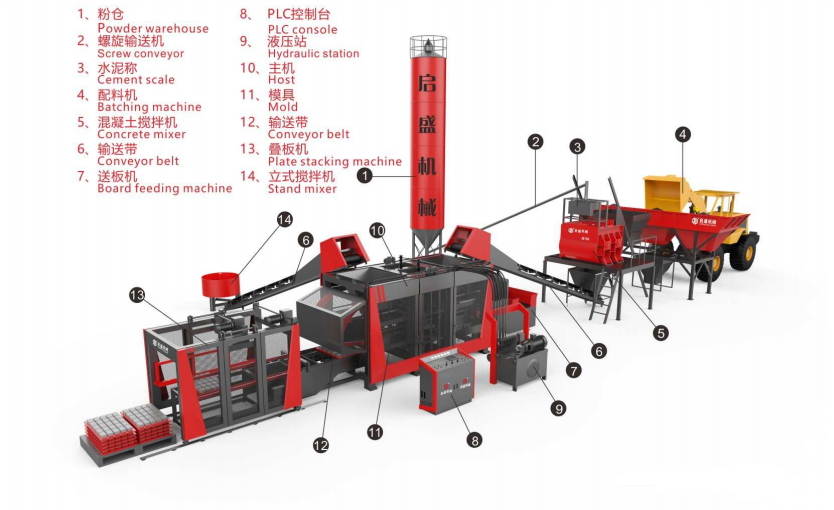
Core Technical Parameters Table
Parameter Item | QST1000 |
|---|---|
Overall Dimensions | 11500×4050×2800(mm) |
Vibration Frequency | 3800–4500(Times/Sub) |
Tray Specifications | 1100×880×25(mm) |
Machine Weight | 16(T) |
Forming Method | Vibration-Pressurized Forming |
Forming Cycle | 15–25(s) |
Excitation Force | 105(KN) |
Rated Pressure | 31.5(MPa) |
Installed Capacity | 48.9(kw) |
Stacker Installed Capacity | 3.7(kw) |
Main Product Specifications and Production Capacity Table
Brick Type | Dimensions (mm) | Blocks per Mold | Theoretical Output in 8 Hours |
|---|---|---|---|
Hollow Brick | 390×190×190 | 10 | 14,400–19,200 |
Porous Brick | 240×115×90 | 24 | 34,560–46,080 |
Standard Brick | 240×115×51 | 51 | 73,440–97,920 |
Colored Floor Tile | 200×100×60 | 36 | 46,800–59,400 |
Precise Target Customer Groups
1. Medium- and large-scale brick-making enterprises: Manufacturers seeking efficient, low-consumption, intelligent mass production with standardized, uniform-quality building materials.
2. Enterprises engaged in solid waste resource utilization: Green and environmentally friendly companies that recycle industrial solid wastes such as fly ash, slag, and coal gangue into bricks.
3. Construction-material suppliers: Companies regularly fulfilling large orders for municipal, landscaping, and architectural blocks, floor tiles, and curbs.
4. Users upgrading traditional brick plants to smart operations: Facilities with outdated equipment characterized by high energy consumption, low efficiency, and high labor costs, seeking technological upgrades to improve productivity and quality.
5. Diversified building-material producers: Manufacturers needing multi-model, flexible mold-changing capabilities to meet varied product demands.
Core Application Scenarios
Mass production of hollow bricks, porous bricks, and curbs for municipal projects.
Batch production of standard concrete blocks for residential construction.
Customized production of colored floor tiles, slope protection bricks, and interlocking blocks for landscape gardening.
Projects utilizing industrial solid waste such as fly ash, slag, and coal gangue to manufacture bricks.
Upgrading traditional small- and medium-sized brick plants toward intelligence, energy efficiency, and higher productivity.
Flexible, customized continuous production of various concrete products.
Industry’s Core Pain Points
Addressing the inefficiency and high energy consumption of traditional equipment: Electro-hydraulic integration upgrades increase production efficiency by 20% while reducing energy use, completely resolving issues of outdated brick machines—slow capacity, high power consumption, and limited profit margins.
Overcoming stepper motor step-loss and poor precision: Servo full-closed-loop control eliminates motor step deviations, ensuring uniform block dimensions and density, thereby solving longstanding problems of unstable forming accuracy and uneven product quality.
Reducing heavy reliance on manual labor and inconsistent mixing ratios: PLC-programmed fixed mix ratios and fully automated operation save 15% on labor costs, avoid human errors in proportioning, and guarantee consistent product quality across batches.
Shortening fault diagnosis and reducing downtime losses: Real-time fault alarms combined with remote maintenance cut troubleshooting time by 30%, greatly minimizing idle periods and ensuring continuous high output.
Alleviating excessive noise and non-compliance with environmental standards: Suspension-type low-noise vibration design reduces noise by 10%, creating a more eco-friendly production environment that meets green factory standards.
Resolving single-machine limitations and high retooling costs: One-click mold changes enable adaptation to multiple brick types, allowing production of all categories of construction and landscaping materials without needing multiple machines, thus lowering equipment investment costs.
Core Investment Value
1. Efficiency and cost-effectiveness, boosting profitability: A 20% increase in production efficiency, lower overall energy consumption, and significant reductions in unit production costs through large-scale batch production—all resulting in higher capacity, better profits, and faster payback periods.
2. Smart labor-saving, reducing operating expenses: Full-process automation plus remote maintenance dramatically decrease on-site operators, saving 15% on labor costs while cutting equipment maintenance and failure-related expenses.
3. Solid waste utilization, generating compliant revenue: Highly adaptable to various industrial solid waste materials, substituting expensive sand and gravel, significantly lowering raw material procurement costs, aligning with environmental policies, and ensuring compliance without risk of rectification.
4. Multi-purpose versatility, expanding order channels: Capable of producing standard bricks, porous bricks, floor tiles, curbs, and other product categories, flexibly adapting to diverse project orders, satisfying diversified production needs, and enhancing market competitiveness.
5. Stable quality, increasing product premium: Servo closed-loop precise forming ensures consistent dimensions, uniform density, and neat appearance across batches, meeting high-end project and export inspection standards, thus commanding higher product premiums.
6. Flexible adaptation, suitable for various facilities: Supports personalized customization plans, adapts to both new and old factories with differing capacity needs; older brick plants can quickly implement technological upgrades, with low entry barriers and exceptional adaptability.
Common Questions FAQ
Q1: What are the core technical advantages of the QST1000 brick-making machine?
A: The machine’s key strengths lie in its electro-hydraulic integration technology and servo closed-loop drive. Compared with traditional brick machines, it delivers higher efficiency, lower energy consumption, and superior forming precision, complemented by eight intelligent systems that enable labor-saving, efficient, low-noise, and low-failure mass production.
Q2: What types of bricks can this equipment produce?
A: By simply changing molds, it can manufacture hollow bricks, porous bricks, standard bricks, colored floor tiles, curbs, slope protection bricks, interlocking blocks, and other concrete products—versatile and widely applicable across different scenarios.
Q3: Does the machine support brick production using solid waste materials?
A: Yes, it can incorporate substantial amounts of industrial solid waste such as fly ash, slag, and coal gangue as substitutes for traditional raw materials. The forming results remain stable, with high solid waste utilization rates, achieving green, energy-efficient production while significantly reducing costs.
Q4: How automated is this equipment, and how much manual labor does it require?
A: The entire process runs intelligently via PLC automation, with fixed mix ratios stored in the system. Remote maintenance is supported, saving 15% on labor costs. No specialized technicians are needed on-site, and the machine is easy for beginners to operate.
Q5: What are the benefits of servo drive compared to ordinary stepper motors?
A: Servo motors provide closed-loop control over position, speed, and torque, eliminating step-loss issues. They offer smoother operation, higher precision, lower noise, faster response, and long-term stability in product quality.
Q6: Is troubleshooting faults convenient?
A: Equipped with a real-time automatic fault alarm system, it accurately locates problem areas. Combined with remote maintenance features, troubleshooting time is shortened by 30%, significantly reducing downtime losses.

Related Products

 Home
Home Tel Consultation
 TOP
TOP