


- Product Details
Core Advantages: Five Key Highlights Reshaping the Block Production Model
1. Wide Range of Raw Material Sources, Significant Cost Advantage
The equipment boasts exceptional compatibility with various raw materials, enabling the extensive use of industrial waste such as fly ash, tailings, industrial slag, and stone powder as primary production inputs. These materials are readily available domestically at low cost, achieving both the resourceful utilization of industrial solid waste and a substantial reduction in raw material procurement expenses, thereby providing enterprises with a significant cost advantage while upholding green and environmentally friendly production principles.
2. Small Investment Scale, High Return Efficiency
The entire production line features a compact equipment layout, with investment costs amounting to only 40%-50% of those for traditional autoclaved aerated concrete production lines, significantly lowering the initial entry barrier for businesses. Meanwhile, the streamlined production process eliminates the need for complex high-pressure steam curing procedures, further reducing operational costs and boosting return on investment, making it an ideal choice for small and medium-sized building materials enterprises looking to enter the field of new wall materials.
3. Green and Energy-Saving Technology, Low-Carbon Environmental Protection
The equipment employs a non-autoclaved production process, eliminating the traditional high-pressure autoclave curing step, which substantially cuts electricity and coal consumption while reducing carbon emissions, representing an eco-friendly production technology. The manufacturing process generates no wastewater or exhaust gases, and since most raw materials are industrial wastes, it achieves the dual goals of resource recycling and low-carbon production, aligning with national environmental protection policy guidelines.
4. Independent Core Technology, Superior Product Performance
The equipment is equipped with a self-developed composite additive that creates an independent closed-cell microstructure within the blocks, greatly reducing water absorption and markedly enhancing freeze-thaw resistance and thermal conductivity. This ensures that the blocks combine high strength with excellent thermal insulation, meeting building energy-efficiency design standards and guaranteeing stable, reliable product quality.
5. Fully Automated Control, Efficient and Worry-Free Production
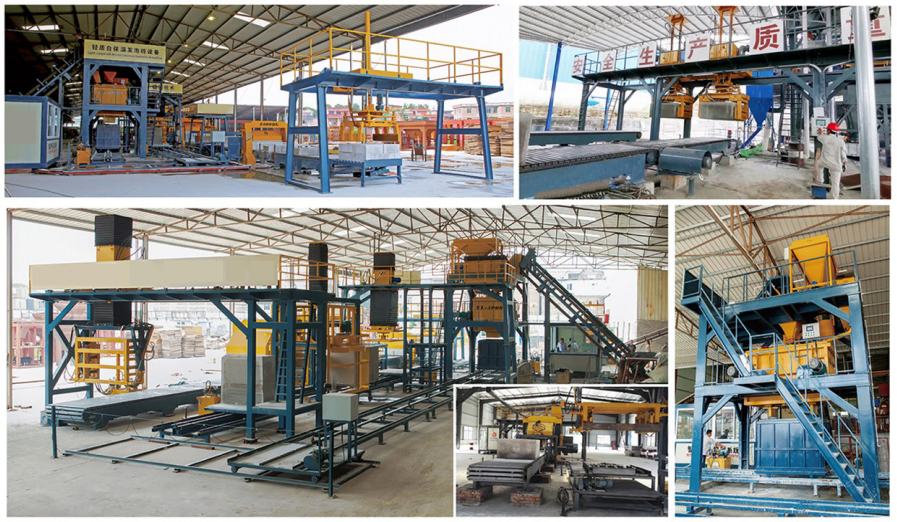
The equipment utilizes fully CNC automated technology, enabling precise control over the entire process—from raw material proportioning and metering, to high-speed mixing, rapid foaming, and molding and conveying. With a high degree of automation and a simplified production workflow, labor input is significantly reduced, while human error is minimized, ensuring consistent and stable product quality and improving overall production efficiency.
II. Complete Production Process Flow: Full-Chain Automation, Highly Efficient and Seamless
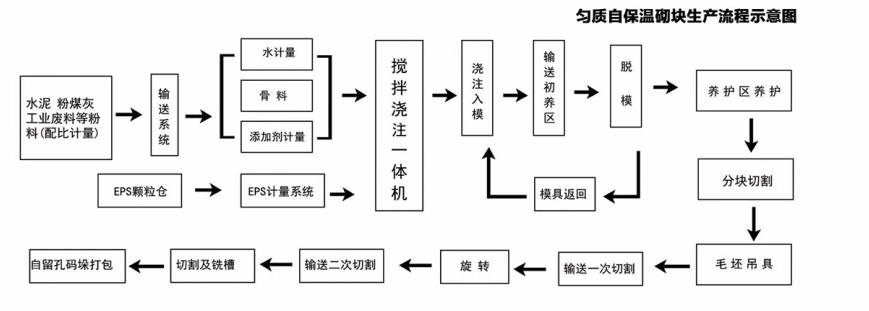
The production process for homogeneous self-insulating blocks achieves fully automated closed-loop operations, with smooth transitions between each stage. The specific process is as follows:
- Raw Material Metering and Conveying: Cement, fly ash, industrial waste, and other powdered materials, along with EPS beads, are precisely measured by a proportioning system and then conveyed to the mixing stage, ensuring accurate and controllable material ratios.
- Integrated Mixing and Pouring: After metering, water, aggregates, additives, and EPS beads are simultaneously fed into an integrated mixer-pourer, where high-speed mixing and rapid foaming produce a uniform lightweight foamed slurry, ensuring thorough blending and even foaming.
- Conveying and Initial Curing: Following pouring into molds, the slurry is conveyed to the initial curing zone for static curing, allowing the block blanks to partially set and take shape, laying the groundwork for subsequent demolding.
- Demolding and Curing: Once initial curing is complete, the molds are removed, and the block blanks proceed to the curing area, where natural or assisted curing processes enhance the blocks’ strength and stability.
- Cutting and Finished Product Handling: After curing, the rough block blanks undergo primary cutting, secondary cutting, and groove milling to form finished blocks that meet specified dimensions. Finally, they are stacked and packaged using self-retaining holes, completing the entire production process.
- Mold Recycling: After demolding, the molds are returned to the pouring stage via a conveyor system, enabling cyclical reuse and further boosting production efficiency while reducing equipment wear and tear.
- The entire process requires no direct human intervention, operating seamlessly in full automation, thus ensuring both high production efficiency and consistent product quality.
Related Products


 Home
Home Tel Consultation
 TOP
TOP