


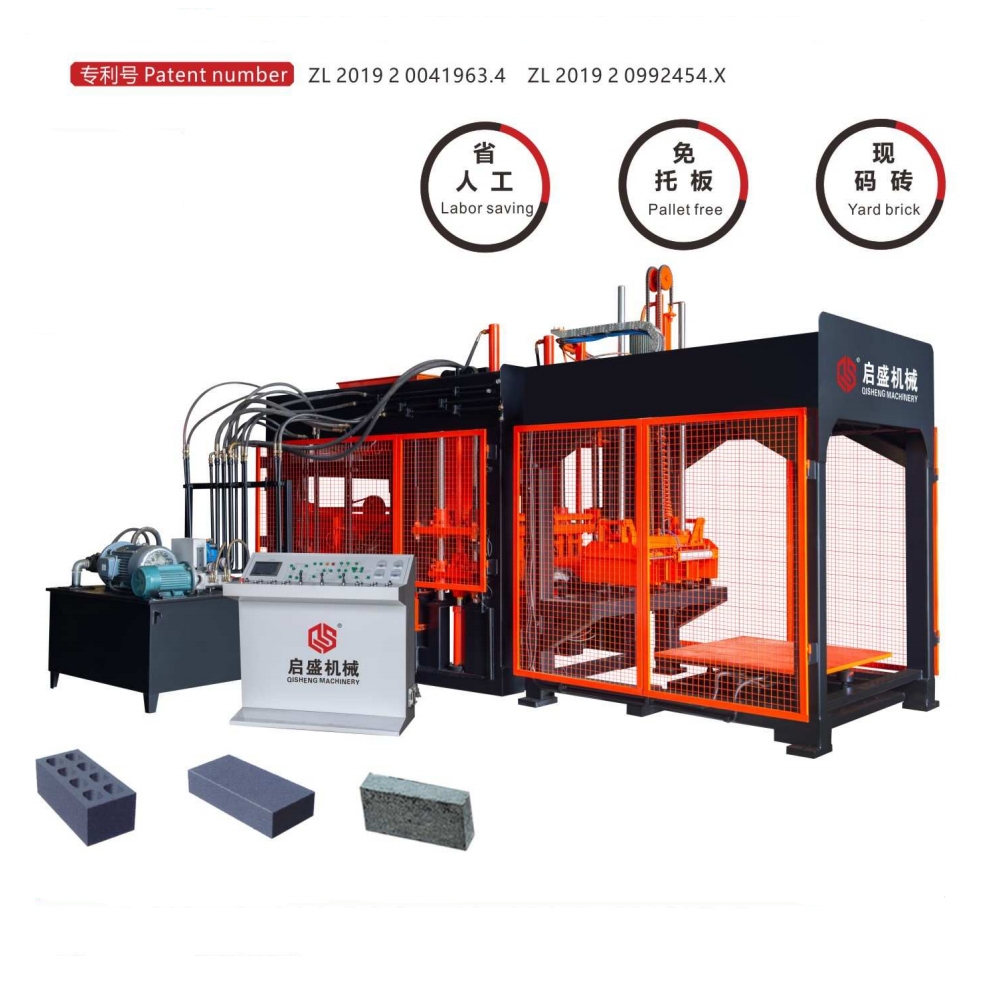

QSMT series (no pallet) wet‑molded block stacking automatic brick‑making machine, QSMT no‑pallet block forming machine, no‑pallet wet‑molded block stacking brick‑making machine, fully automatic block
QSMT series (no pallet) wet-batch stacking automatic block molding machine
Fully automatic block molding machine
Concrete forming machine
- Product Details
Product Overview
The QSMT series (tray-free) wet-batch palletizing automatic block molding machine adopts a self-developed integrated brick-making and palletizing high-efficiency operating system.
It is equipped with advanced electrical, pneumatic, and hydraulic control systems.
An AI intelligent program enables multi-dimensional automatic judgment.
A smart human-machine interaction system provides bionic adaptive dynamic pressure adjustment.
It features real-time monitoring of operating status, automatic fault diagnosis, automatic shutdown, and display of solutions.
It uses a Japanese-imported hydraulic multi-way vector control system.
High efficiency and stability, precise control, high-density rapid molding, and powerful performance.
One brick machine per pallet, bricks are palletized immediately upon exiting, achieving high efficiency and energy savings. Quick loading and unloading saves labor, money, and worry.
It is suitable for producing standard solid bricks, porous bricks, and other small-sized non-fired blocks.
Name | QSMT500 | QSMT1000 |
|---|---|---|
Vibration Frequency | 3200–4600 times/min | 3200–4600 times/min |
Machine Power | 39.5 kW | 57.5 kW |
Machine Weight | ~8000 kg | ~12000 kg |
Dimensions | 5800×1800×2750 mm | 6800×1800×2750 mm |
Molding Cycle | 13–18 s | 13–18 s |
Nominal Pressure | 21 MPa | 21 MPa |
Vibratory Force | 68 KN | 150 KN |
Molding Area | 1150×560 mm | 1150×1100 mm |
Molding Method | Vibration-Press Molding | Vibration-Press Molding |
Palletizing Method | Wet-Batch Online Cross-Palletizing | Wet-Batch Online Cross-Palletizing |
Palletizing Height | 1100 mm (10 layers of standard bricks) | 1100 mm (10 layers of standard bricks) |
Selling Points:
Revolutionary tray-free design, completely eliminating reliance on pallets
Integrated wet-batch automatic palletizing, enabling full-process unmanned operation
Composite vibration-press molding, delivering stable quality far surpassing traditional equipment
Strong adaptability to solid waste, highlighting policy benefits
Compact structure with small footprint, suitable for upgrading both new and existing plants
Energy-saving, low-noise, and environmentally friendly
Multi-purpose versatility, capable of flexible production changes and strong adaptability to market fluctuations
Target Customer Groups:
Large-scale brick manufacturing enterprises (key needs: tray-free, labor-saving, efficiency improvement)
Solid waste resource utilization companies (key needs: solid waste compatibility, environmental compliance, policy adaptation)
Traditional pallet-based brick machine users (key needs: eliminating pallets, saving labor, renovating facilities)
New brick manufacturing enterprises and rural/township building material factories (key needs: space-saving, labor-saving, easy maintenance)
Application Scenarios: Suitable for various large, medium, and small-scale brick factories, capable of producing multiple types of blocks for civil construction, municipal projects, landscaping, and other applications; tray-free, automatic palletizing, and fully unmanned operation enhance efficiency, reduce costs, and meet the demands of large-volume project orders.
Addressing Pain Points:
Resolving the core pain points of traditional pallet-based brick machines—high pallet costs, significant wear and tear, and cumbersome management
Alleviating the labor-related pain points of wet-batch operations—dependence on manual brick handling and stacking, high labor intensity, and difficulty in recruiting workers
Overcoming the efficiency challenges of conventional equipment—long processes, large footprints, numerous machines, and frequent breakdowns
Solving the adaptation issues of solid waste raw materials—difficulty in molding, tendency to loosen, and low utilization rates
Addressing compliance concerns of older equipment—excessive noise, high dust levels, and failure to meet environmental standards
Mitigating labor dependency, recruitment difficulties, and high labor intensity
Resolving the upgrade challenges of older plants—small spaces, difficult renovations, long timelines, and substantial investments
Countering business risks associated with product monotony, limited order acceptance, and weak risk resilience
Value Delivered to Customers:
1. Significant cost reduction: Tray-free design eliminates all pallet-related expenses (saving 100,000–200,000 yuan annually); replaces 8–12 workers, reducing labor costs by 400,000–600,000 yuan per year; lowers raw material costs by 25%–45%, energy consumption by 20%–30%, and maintenance costs by over 40%.
2. Enhanced production efficiency: 24-hour unmanned continuous production boosts capacity by 30%–50% compared to traditional equipment (producing 8,000–24,000 standard bricks daily), with an operational rate exceeding 95% and annual downtime losses reduced by 80,000–150,000 yuan.
3. Improved product quality: Composite vibration-press molding ensures a breakage rate of ≤0.5% and a pass rate of ≥99%; compressive strength reaches MU12–MU25, enabling participation in high-end projects, increasing selling prices by 10%–18%, and boosting annual revenue by 200,000–400,000 yuan.
4. Simplified operations management: Fully automated process allows ordinary workers to master it within one day without requiring specialized technicians; replacing 8–12 workers resolves recruitment and retention challenges, cutting management costs by 50,000–80,000 yuan annually.
5. Increased site utilization: Compact structure reduces land use by over 30%, shortens line length by 40%, eliminates pallet storage space, saving 50,000–120,000 yuan annually in factory rent/expansion costs, ideal for tight-space scenarios.
6. Realization of policy benefits: With solid waste utilization rates ≥85% and compliance with environmental standards, eligible for solid waste resource utilization subsidies (50,000–150,000 yuan annually), avoiding environmental rectification and fines (saving 50,000–100,000 yuan annually).
7. Strengthened risk resilience: Rapid mold changes enable production of over eight types of blocks, quickly responding to market shifts and expanding order scope, reducing annual order loss by 100,000–200,000 yuan and lowering overall business risk.
8. Attractive return on investment: Payback period only 2–3 years (QSMT6/8 about 2–2.5 years, QSMT10/12 about 2.5–3 years); equipment lifespan of 10–12 years, offering outstanding long-term value, with annual additional output value of 800,000–1.8 million yuan.
QSMT500 Production Capacity Table
Name | Specification | Bricks/Mold | Bricks/8 Hours |
|---|---|---|---|
Standard Brick | 240×115×50 mm | 36 | ~65,000 bricks per shift |
Porous Brick | 240×115×90 mm | 16 | ~28,000 bricks per shift |
Matching Brick | 190×115×49 mm | 45 | ~83,000 bricks per shift |
QSMT1000 Production Capacity Table
Name | Specification | Bricks/Mold | Bricks/8 Hours |
|---|---|---|---|
Standard Brick | 240×115×50 mm | 72 | ~135,000 bricks per shift |
Porous Brick | 240×115×90 mm | 32 | ~57,000 bricks per shift |
Matching Brick | 190×115×49 mm | 90 | ~170,000 bricks per shift |
Frequently Asked Questions (FAQ)
Q1: What is the core difference between tray-free brickmaking and traditional pallet-based brickmaking?
A: This machine requires no pallet assistance; wet bricks are directly molded and palletized online, completely eliminating costs associated with pallet procurement, wear and tear, storage, and management. The process is more streamlined, occupies less space, and boasts higher automation.
Q2: Can the equipment use solid waste materials such as construction debris or tailings?
A: Absolutely compatible. It can handle sand, fly ash, construction waste, tailings, steel slag, and other types of solid waste, achieving a solid waste utilization rate of over 85%, ensuring environmental compliance, and qualifying for policy subsidies.
Q3: How automated is the equipment, and how much manpower does it require?
A: Fully unmanned automatic production, capable of continuous operation 24 hours a day, requiring only minimal staff supervision. It can replace 8–12 traditional workers, significantly easing labor pressures.
Q4: Is the quality of finished blocks stable, and is the breakage rate high?
A: Utilizing composite vibration-press molding combined with AI-adaptive pressure regulation, the finished products are dense, uniform, and consistently strong, with a breakage rate of ≤0.5% and a pass rate of ≥99%, far surpassing traditional brickmaking equipment.
Q5: Is the equipment suitable for upgrading and renovating older brick factories?
A: The entire machine has a compact structure, occupies little space, and requires minimal infrastructure modifications. Short construction periods and low investment make it perfectly suited for automating and greening older brick factories.
Q6: Does the equipment support production of multiple brick types?
A: It supports quick mold changes, enabling production of standard bricks, hollow bricks, porous bricks, permeable bricks, slope protection bricks, curbs, and over eight other types of blocks, meeting diverse production needs.
Note: The above production figures are theoretical calculations; actual output may vary due to factors such as molding cycles, raw material ratios, and product types.
Related Products


 Home
Home Tel Consultation
 TOP
TOP