


- Product Details
Equipment Introduction
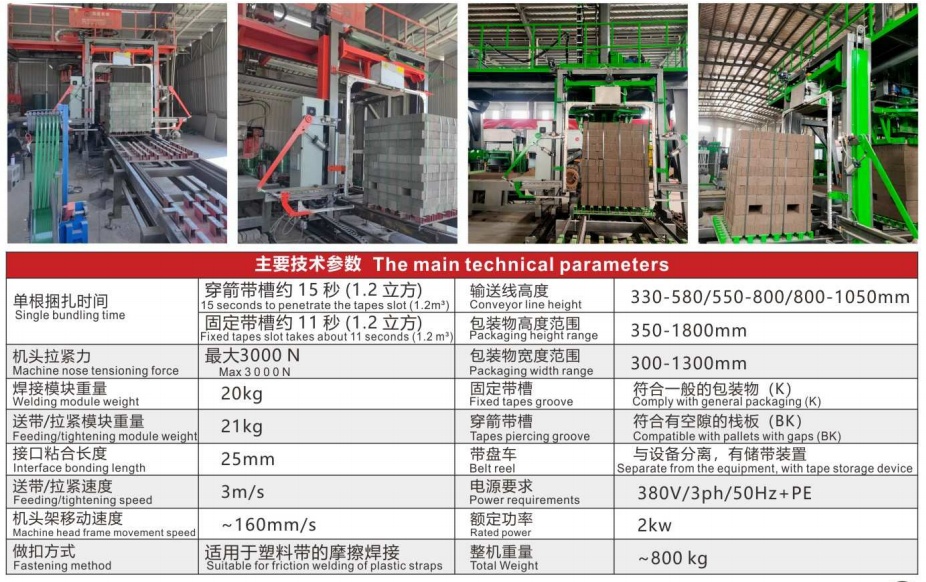
The QSPY-16A traversing automatic strapping machine is a fully automatic strapping device designed by Qisheng Machinery to meet the packaging needs of finished brick stacks in the brick-making industry. It features a traversing strap‑feeding mechanism, ensuring smooth operation, precise positioning, no strap jams, and no scratching of bricks. The machine can seamlessly integrate with stacking systems and conveyor lines, enabling automated packaging and handling of brick stacks.
The equipment employs PLC intelligent control and photoelectric sensing for positioning, automatically completing the entire process of strap feeding, tightening, heat‑sealing, cutting, and resetting. It is compatible with PET plastic steel straps, delivering secure strapping, neat joints, stable stacks, and intact packages, meeting the packaging requirements of various brick types, including standard bricks, hollow bricks, porous bricks, and concrete blocks.
The machine boasts features such as a stable traversing strap‑feeding system, self‑diagnostic fault detection, and adjustable strapping tension. Its robust and durable structure is easy to maintain, accommodating brick stacks with widths ranging from 1 to 1.5 meters. With high packaging efficiency and reliable operation, it serves as a key auxiliary device for achieving unmanned, standardized packaging on brick production lines, effectively boosting packing productivity, reducing labor costs, and standardizing finished‑product shipping criteria.
Application Scenarios
Standardized packaging of brick stacks at the end of fully automated brick production lines
Strapping and handling of finished stacks of aerated concrete blocks, permeable bricks, and paving bricks during warehousing and transportation
Pre‑packaging procedures prior to container loading for export bricks
Automation upgrades of manual strapping stations in older brick factories
Integration with intelligent hole‑preserving stacking lines and forklift clamp‑type complete automated production lines
Solving Industry Pain Points
Addressing the production challenges of low manual strapping efficiency, heavy labor demands, and insufficient capacity to handle large‑scale shipments;
Overcoming the issues of traditional fixed‑type strappers—strap jams and metal frame abrasion causing damage and high spoilage rates;
Eliminating inconsistencies in strapping tightness and messy joints that lead to uneven product appearance and affect overseas project acceptance;
Dealing with outdated strapping equipment lacking automatic diagnostics, resulting in time‑consuming troubleshooting and frequent downtime that disrupts continuous line operations;
Resolving the inability of conventional strapping machines to interface with stacking and conveying equipment, requiring manual transfer and hindering full‑process automation.
Core Product Value
1. Dramatic reduction in labor costs: Fully automated, unmanned strapping eliminates the need for dedicated strapping workers, continuously lowering factory labor expenses over the long term;
2. Significant decrease in finished‑product losses: The traversing strap‑feeding mechanism prevents brick scratches, reducing breakage rates and minimizing waste of raw materials and finished goods;
3. Standardized shipping, enhancing order‑winning competitiveness: Uniform strapping tension and neat joints ensure stable stacks without loose packages, meeting aesthetic standards required for international exports and large municipal projects;
4. Compatibility with automated assembly lines, unlocking overall plant capacity: Seamless integration with stacking and conveying equipment enables uninterrupted, continuous production across the entire line, boosting daily output;
5. Simple maintenance and reduced downtime: Self‑diagnostic fault detection speeds up troubleshooting, while the robust, durable design ensures high equipment availability, minimizing losses due to production stoppages.
Frequently Asked Questions (FAQ)
Q1: What kind of strap‑feeding mechanism does the QSPY-16A strapping machine use, and will it scratch the bricks?
A: It uses a traversing strap‑feeding mechanism that operates smoothly and gently, with precise positioning. During strapping, there are no strap jams, and no scraping or damage to the brick stack.
Q2: What controls does the equipment rely on, and can it operate fully automatically?
A: Equipped with a PLC intelligent control system and photoelectric sensing for positioning, the machine automates all processes—including strap feeding, tightening, heat‑sealing, cutting, and resetting—enabling unattended operation.
Q3: What strapping material is used, and is the strapping secure?
A: Compatible with PET plastic steel straps, the heat‑sealed joints are smooth and tightly bound, making the package resistant to loosening or tearing during transport.
Q4: What width of brick stacks can the equipment handle, and which types of bricks can it pack?
A: Suitable for brick stacks with widths ranging from 1 to 1.5 meters, it can handle standard bricks, hollow bricks, porous bricks, and various concrete blocks.
Q5: Can it be integrated with stacking lines and conveyor systems?
A: Yes, it can seamlessly connect with stacking systems and finished‑product conveyor lines, enabling continuous automated packaging and handling of brick stacks.
Related Products


 Home
Home Tel Consultation
 TOP
TOP