


- Product Details
Product Overview
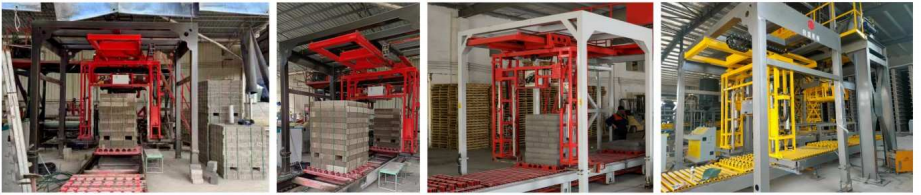
The QSSX-16A overhead rotary automatic strapping machine is a fully automated strapping system specially developed by Qisheng Machinery for the packaging process of finished brick stacks in the brick-making and building materials industries. The entire machine features a unique overhead rotary strapping structure, with a compact body and a small footprint, enabling seamless integration with various fully automated brick production lines and intelligent palletizing systems. This achieves continuous automated flow from forming, stacking, to packaging, realizing standardized, unmanned packaging of brick stacks.
The equipment is equipped with a PLC intelligent control system paired with photoelectric sensing positioning components, allowing the entire strapping process to run automatically in a closed loop. It completes all operations—belt feeding, tensioning, heat-sealing, belt cutting, and mechanism resetting—without any manual intervention for belt threading, strapping, or belt trimming. The machine supports PET plastic steel strap strapping, with heat-sealed joints that are firmly bonded, ensuring that brick stacks remain secure during storage and long-distance transportation without loosening or breaking open. Standard 1.2 cubic meter brick stack packaging takes only about 11 seconds, and its arrow-type strap groove design accommodates spaced pallets, adapting to various on-site packaging conditions. The machine boasts a solid and robust structure, low failure rates, and simple routine maintenance, making it compatible with standard bricks, hollow bricks, porous bricks, and various concrete block finished stack packaging. It is an economical auxiliary device for building material factories seeking to automate their downstream packaging processes, ensure uniform product appearance for shipment, and reduce labor costs.
Working Principle
1. Linked Feeding: Finished brick stacks are conveyed to the strapping station via a conveyor line. Photoelectric sensors automatically detect the position of each stack, transmitting signals to the PLC controller;
2. Overhead Rotary Strapping: An overhead rotary mechanism smoothly wraps around the brick stack, accommodating spaced pallets and forming a complete strapping circuit encircling the entire stack;
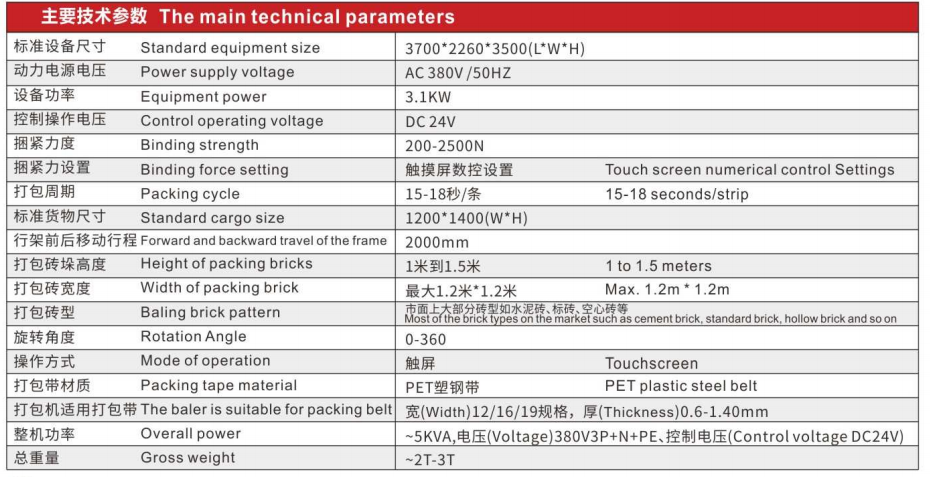
3. Tension Control: The equipment tightens the plastic steel strap according to a preset tension range of 200–2500N, ensuring firm and even strapping;
4. Heat-Sealing and Cutting: A heating module thermally seals the strap joints, followed by automatic belt cutting to remove excess material;
5. Automatic Reset: After packaging is complete, the overhead rotary mechanism automatically returns to its original position, and the finished brick stack is conveyed to the storage or loading area, continuing the cycle of uninterrupted operation.
Key Selling Points
1. Compact Overhead Rotary Structure, Smaller Footprint Suitable for Tight Factory Spaces
Featuring a dedicated overhead rotary wrapping design, the machine has a small overall size, requiring no large installation space. Even older brick factories with cramped back-end workstations can directly install and retrofit this equipment, making it ideal for building material enterprises with limited space.
2. Fully Automated PLC + Photoelectric Control, Unmanned Operation Saves Labor Costs
Photoelectric sensors automatically detect and position the stack, integrating belt feeding, tensioning, heat-sealing, and belt cutting into a single automated process. This eliminates the need for dedicated strapping workers, significantly reducing labor and management expenses associated with packaging positions.
3. PET Plastic Steel Strap Heat-Sealing, Ensures Strong, Secure Strapping Without Loosening
A unified heat-sealing process produces smooth, high-strength joints, preventing loose or broken packages during stacking and long-distance container transport, thus maintaining consistent appearance standards for export and construction projects.
4. High-Speed Packaging Efficiency, Suited for Large-Scale Mass Production
Standard 1.2 cubic meter brick stack packaging takes only 11 seconds per cycle, matching the pace of fully automated brick-making and palletizing lines without slowing down overall production capacity.
5. Universal Arrow-Type Strap Groove Design, Compatible with Palletized Operations
Even spaced pallets can be threaded and strapped normally, eliminating the need to dismantle pallets before strapping, thus supporting both palletized and pallet-free production modes.
6. Wide Adjustable Tension Range, Adaptable to Different Weight Bricks
The strapping tension can be freely adjusted between 200–2500N, allowing lightweight blocks and dense heavy brick stacks to achieve appropriate tightening levels, avoiding crushing bricks or loose strapping.
7. Robust Construction with Low Failure Rate, Simple Maintenance and Low Operating Costs
The machine’s mechanical structure has been simplified and optimized, with highly wear-resistant components and fewer potential failure points. Routine cleaning and component replacement are straightforward, minimizing downtime and lost productivity.
8. Full Line Compatibility and Dual-Use Capability
It can operate independently as a standalone unit for warehouse packaging, or seamlessly connect with brick-making hosts and automated palletizing equipment, achieving full-process automation from forming to stacking to packaging.
Precise Target Customer Groups
1. Building material factories producing standard concrete bricks, hollow blocks, permeable bricks, and curbs;
2. Large-scale brick factories equipped with fully automated palletizing lines and seeking to supplement their backend automated packaging processes;
3. Small and medium-sized brick-making enterprises with cramped back-end spaces unable to install large side-rotating or cantilever-style packaging equipment;
4. Export-oriented brick manufacturers with stringent requirements for finished-product packaging neatness and transport protection;
5. Customers looking to upgrade aging semi-automatic brick-packaging stations with cost-effective automation solutions;
6. Distributors of complete building-material equipment sets needing to stock auxiliary machinery for whole-line packaging.
Core Application Scenarios
Continuous automated packaging of finished brick stacks at the end of fully automated brick-making production lines;
Packaging operations for finished masonry blocks transported on palletized racks;
Technical upgrades and retrofits of back-end packaging stations in cramped, aging brick factories;
Standardized strapping of exported brick products suitable for long-distance container transport;
Independent warehouse packaging operations for small and medium-sized building-material factories;
Integration with fixed palletizers and forklift clamp systems to form complete automated production lines.
Addressing Core Industry Pain Points
Resolving the pain point of slow manual brick-strapping speeds, excessive labor demands, and insufficient production capacity to meet bulk shipment schedules;
Overcoming the limitation of traditional large packaging machines occupying vast floor space, making them unsuitable for small factory installations;
Eliminating inconsistencies in manual strapping tightness and messy joint arrangements, which lead to uneven product appearances affecting overseas project acceptance;
Common packaging equipment offers fixed tension settings, causing lightweight bricks to crush easily while heavy bricks become loosely strapped, with limited adaptability to different brick types;
Older packaging machines cannot accommodate spaced pallets, requiring manual removal of pallets before packaging, adding extra handling steps;
Manual packaging jobs are physically demanding, difficult to recruit for, and face rising wages, resulting in high long-term operating costs;
Automation gaps in backend packaging processes hinder the full intelligent upgrading of entire brick-making production lines.
Core Value Delivered Upon Implementation
1. Significant Reduction in Labor Input: Fully automated, unmanned packaging replaces 2–3 dedicated strapping workers, saving labor wages and management expenses over time;
2. Cost-Effective Upgrading for Tight Factory Spaces: With its small footprint, the equipment requires minimal infrastructure modifications, allowing rapid installation in older facilities and lowering the threshold for technical upgrades;
3. Dramatic Reduction in Product Losses: Precisely controllable tension prevents damage to masonry blocks, while firm strapping eliminates transport-related breakage and loss, reducing scrap rates;
4. Enhanced Production Line Capacity and Shipping Efficiency: Each packaging cycle takes only 11 seconds, seamlessly connecting with front-end palletizing equipment to break through backend bottlenecks and increase daily shipment volumes;
5. Standardized Packaging Appearance Boosts Order-Winning Competitiveness: Uniform, neat strapping meets overseas customer and large municipal project acceptance standards, enhancing product market reputation;
6. Versatile Multi-Scenario Use, High Equipment Reusability: Can be used with palletized racks or paired with pallet-free palletizing lines, adapting to multiple production modes without needing multiple packaging units;
7. Low-Failure, Easy-Maintenance Design Ensures Continuous Production: Streamlined, wear-resistant structure with low failure rates reduces downtime for repairs, stabilizes equipment utilization, and lowers losses due to production stoppages.
Frequently Asked Questions (FAQ)
Q1: What is the structural design of the QSSX-16A, and how does it differ from cantilever-style packaging machines?
A: This machine employs an overhead rotary strapping structure, featuring a compact body and a much smaller footprint than cantilever models, making it ideal for installation in cramped back-end factory spaces. Its arrow-type strap groove design allows normal packaging even when using spaced pallets.
Q2: Can this equipment be integrated with palletizing production lines for simultaneous use?
A: Yes, it seamlessly connects with various fully automated palletizing devices and brick-making hosts, enabling automated linkage across forming, stacking, and packaging processes. It can also be used independently as a standalone unit.
Q3: Is the strapping tension adjustable, and what types of bricks is it suitable for?
A: The strapping tension is widely adjustable between 200–2500N, making it compatible with standard bricks, hollow bricks, porous bricks, and various concrete block stacks of differing weights.
Q4: How long does it take to package a standard 1.2-cubic-meter brick stack?
A: Under standard conditions, each packaging cycle takes approximately 11 seconds, with a fast packaging rhythm suited to large-scale continuous mass production.
Q5: What kind of packaging consumables are used, and how strong is the bond?
A: The machine uses PET plastic steel straps and a heat-sealing bonding process, producing strong, smooth joints that resist loosening or breakage during long-distance transport.
Q6: Our factory space is very limited—can this equipment still be installed?
A: Thanks to its compact overhead rotary design and small footprint, this machine can be directly installed even in cramped back-end areas of older, smaller brick factories, with minimal retrofitting difficulty.
Related Products


 Home
Home Tel Consultation
 TOP
TOP