


- Product Details
Performance Features of the CMP Vertical Shaft Planetary Mixer
The Qisheng vertical shaft planetary mixer is innovatively developed based on German technology.
Smooth transmission and high efficiency: Equipped with a hardened gear reducer, it delivers low noise, high torque, and exceptional durability.
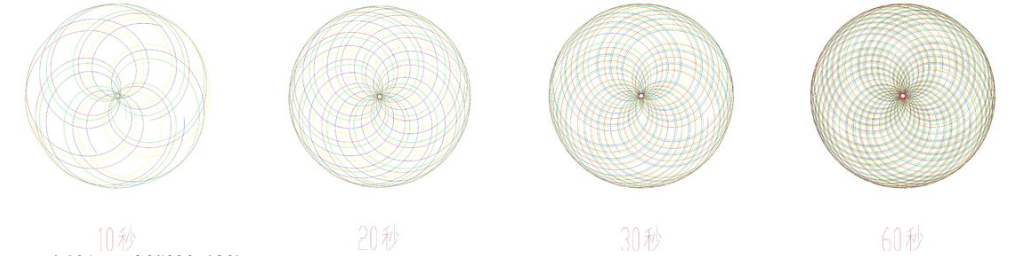
Uniform mixing with no dead zones: The mixing blades operate through a combination of revolution and rotation, ensuring their motion path covers the entire mixing drum.
Broad mixing range: Suitable for blending various special materials such as aggregates and powders.
Easy cleaning: Optional high-pressure cleaning system with spiral nozzles providing extensive coverage. Flexible configuration and rapid discharge: Offers 1–3 discharge doors to meet diverse production line requirements.
Convenient installation and maintenance: Large maintenance access door equipped with safety switches.
Customizable mixing units: Mixing devices can be tailored according to customer needs.
Excellent sealing: Eliminates slurry leakage issues.
Diagram of Revolution and Rotation Motion Paths
The following image illustrates the mixing motion trajectory of the Qisheng CMP vertical shaft planetary mixer from 5 seconds to 60 seconds after material addition. Each time the planetary mixer completes one cycle, it fully covers the bottom of the mixing tank without leaving any dead zones.
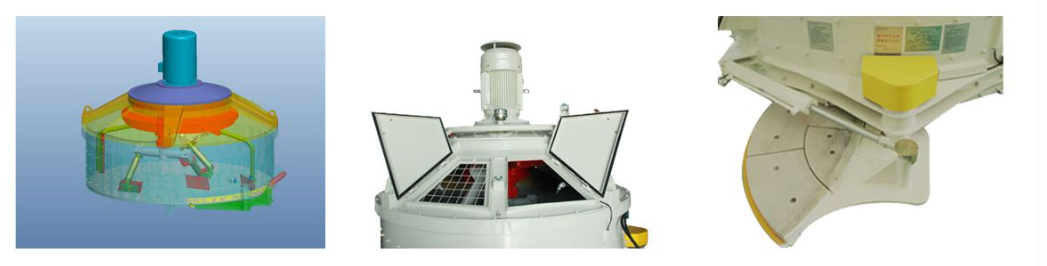
Structure of the Vertical Shaft Planetary Mixer
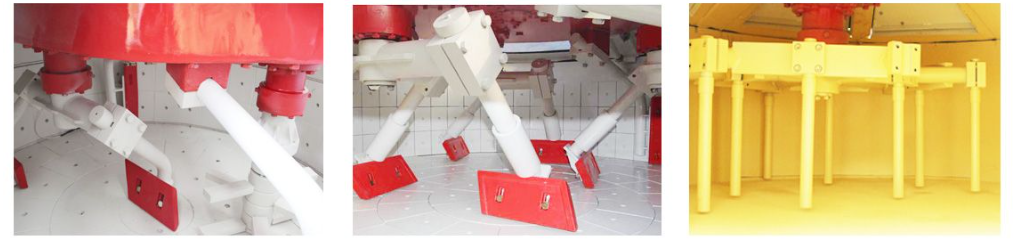
Mixing System
Standard mixing and differential-speed mixing options enable broader material blending capabilities.
The mixing arms feature streamlined designs to reduce material adhesion and extend machine lifespan; wear-resistant protective sleeves are incorporated into the mixing mechanism. Practical experience shows this design doubles the service life of the mixing arms.
The vertical shaft planetary mixer employs reinforced scraper structures to eliminate mixing dead zones.
Mixing liner and blade materials are selected based on the user’s industry: wear-resistant alloy inserts, stainless steel, ceramic, high-chromium alloys, surfacing materials, polyurethane, highly wear-resistant rubber, and cast stone.
Mixing Unit
The parallelogram-shaped mixing blades (patented product) can be flipped 180° for repeated use, doubling utilization efficiency.
Discharge System
Hydraulic or pneumatic discharge doors can be selected as needed, with 1–3 doors available. Special sealing devices installed on the discharge doors ensure tight sealing, reliable control, and zero leakage, making them environmentally friendly.
Maintenance Door and Safety Devices
A large maintenance door facilitates servicing and cleaning, equipped with highly sensitive safety switches for safe and convenient operation.
Water Supply System
The water supply system adopts an overhead design to address residual admixtures and water in pipelines, preventing losses when customers change formulations. Spiral solid-cone nozzles deliver fine, uniform atomization with wide coverage, resulting in more even material mixing.
Target Customer Groups
Manufacturers of permeable bricks and high-end landscape bricks, specialized precast concrete producers, dry-hardness unburned brick processing plants, medium- and large-scale complete brick-making equipment enterprises, overseas purchasers of high-end building material production lines, construction waste recycling facilities, and precast hydraulic engineering material manufacturers.
Applicable Materials & Application Scenarios
1. High-end building material blending: Dedicated dry-hardness concrete mixing for permeable bricks, imitation stone bricks, pavement bricks, and grass-embedded bricks.
2. Special material blending: High-strength special concretes, admixture-modified aggregates, and homogeneous powder mixing operations.
3. Complete production line integration: Supporting fully automatic static brick pressing lines, aerated block production lines, and mainframe support for precast concrete component production lines.
4. Multi-formula mass production: Switching between multiple brick types and frequent formula changes in large-scale building material manufacturing facilities.
Addressing Pain Points in Traditional Mixer Industry
Solves traditional horizontal mixers’ problems of dead zones, sedimentation at the bottom, layered mixing, and uneven strength in finished bricks.
Overcomes shortcomings of older mixers—uneven water addition, residual admixtures, significant material loss during formula changes, and excessive raw material waste.
Eliminates common issues like poor sealing, slurry leakage,厂区 dust and dirt, non-compliant environmental standards, and heavy cleanup burdens.
Addresses single-sided wear of conventional mixing blades, frequent replacements, high consumable costs, and downtime caused by part changes.
Resolves deficiencies of older reducers—insufficient torque, loud noise, and frequent breakdowns—making them unsuitable for handling dry-hardness, high-strength materials.
Fixes slow discharge through single discharge doors, which cannot keep pace with high-production-line rhythms and limit overall brick-making capacity.
Core Production Value
1. Quality improvement and efficiency gains: Comprehensive 5-second mixing coverage, fast blending speed, superior material homogeneity, consistent brick density, and guaranteed strength, enhancing the ability to accept high-end project orders.
2. Cost reduction and durability: Patented reversible blades combined with wear-resistant arm protection double component lifespan and cut long-term consumable expenses in half.
3. Flexible adaptability: Dual mixing modes, multiple discharge doors, and various wear-resistant materials allow a single mixer host to handle all brick types and materials across the plant.
4. Hassle-free operation and maintenance: Safe maintenance doors paired with low-failure hardened gear transmissions minimize downtime, ensuring high annual equipment availability.
5. Environmental compliance: Full-seal anti-leakage design, overhead water-saving systems, optional high-pressure self-cleaning features—all meeting domestic and international environmental assessment standards.
Frequently Asked Questions (FAQ)
Q1: What is the difference between the CMP vertical shaft planetary mixer and a conventional horizontal mixer?
A: This machine employs three-dimensional revolution and rotation mixing, achieving full coverage within 5 seconds without dead zones, ideal for dry-hardness, high-end materials. Traditional mixers suffer from dead zones and uneven mixing, making them unsuitable for producing permeable bricks or other specialized materials.
Q2: Can the mixing blades be used on both sides?
A: Featuring patented parallelogram-shaped blades that can be flipped 180° for dual-sided use, significantly doubling component lifespan and utilization efficiency.
Q3: Will there be slurry leakage issues?
A: All discharge doors and the main shaft are fitted with exclusive sealing structures, delivering excellent airtight performance. Under normal operating conditions, there will be no slurry leakage or overflow.
Q4: Can formulas be changed to blend different materials?
A: Designed for frequent formula changes, with overhead water supply eliminating residual admixtures, thus avoiding new-old material mixing losses and enabling easy formula switching.
Q5: Can the number of discharge doors be customized?
A: Supports selecting 1, 2, or 3 discharge doors, with either hydraulic or pneumatic drive options, adaptable to varying production line capacities.
Related Products


 Home
Home Tel Consultation
 TOP
TOP