


QS-1200A Low-Position Automatic Palletizer
QS-1200A Low-Position Automatic Palletizer
Automatic palletizer
- Product Details
The QS-1200A low-position automatic palletizing system is a specialized automated palletizing device designed for brick production lines. It is tailored for various concrete blocks, standard bricks, porous bricks, and paving bricks, and can be seamlessly connected to the discharge end of the forming machine to achieve fully unmanned operation throughout the entire process—brick separation, orderly arrangement, automatic palletizing, and pallet circulation. It is a core supporting equipment that helps brick factories replace manual palletizing, reduce costs, and improve efficiency.
The equipment features a low-position floor-mounted layout, eliminating the need for high-level infrastructure or lifting brackets, making installation highly flexible. It can be independently positioned next to the finished-product curing area or directly integrated into the entire brick-making production line for on-line, real-time palletizing, making it suitable for both new and existing production line upgrade projects. The total weight of the machine is approximately 11,000 kg, with a total power rating of 29.5 kW, including a 7.5 kW top-plate motor and a 14.2 kW conveying system. It operates stably with controllable energy consumption. Standard palletizing dimensions can reach 1200×1200×1400 mm, with a single-layer palletizing cycle of about 18 seconds. A single shift per day can complete nearly 3,800 pallets of finished products, far surpassing the output of manual labor teams.
| Parameter | QS-1200A Specification |
|---|---|
| Total Machine Power | 29.5 kW (7.5 kW for the top plate + 14.2 kW for conveying) |
| Maximum Palletizing Dimensions | 1200×1200×1400 mm |
| Single-Layer Palletizing Cycle | Approximately 18 seconds per layer |
| Machine Weight | Approximately 11,000 kg |
| Compatible Brick Types | Four major categories and 15 common types of building blocks |
| Operating Mode | Dual-mode palletizing: with pallets or without pallets |
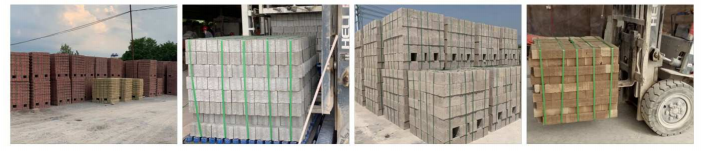
The entire system relies on a PLC + touch-screen intelligent control system, paired with laser sensors and multiple high-precision sensors, enabling closed-loop automated operation across all processes. The equipment can automatically distinguish between different specifications of finished bricks, separating brick slabs and arranging individual bricks into neat, standardized square stacks. The stacked bricks are compact and orderly, allowing multi-layer stacking. Once palletizing is complete, the bricks can be directly conveyed via conveyor belt to the packaging station or the forklift transfer area—supporting both palletized stacking and bare-stack storage, thus meeting diverse warehousing and transportation needs. The equipment also features built-in self-diagnostic fault alarms; when issues such as jammed bricks or misaligned pallets occur, it automatically stops and alerts operators, significantly reducing brick breakage and equipment failure rates.
The equipment boasts exceptional compatibility, adapting to four major categories and fifteen commonly used brick specifications available on the market. By simply replacing tooling, users can switch between different brick types, making the machine versatile and suitable for producing standard bricks, hollow blocks, slope protection bricks, permeable bricks, and other product varieties. The pallets used in the system operate in a closed-loop cycle: empty pallets are automatically returned, cleaned, loaded, and reused, eliminating the need for frequent manual handling. With only one operator required to oversee the entire line, this setup saves substantial labor costs annually compared to traditional manual palletizing, while also avoiding problems like skewed stack formations and damage caused by human error.
Backed by mature hydraulic drive and mechanical transmission systems, the machine’s frame is constructed from thickened steel welded together, and its wear-resistant components undergo heat treatment, ensuring stable and durable performance during continuous 24-hour operation. Routine maintenance is simple and convenient. After palletizing, the finished stacks are neatly compacted, facilitating film wrapping, warehouse storage, and long-distance transport, effectively improving finished-product storage utilization and shipping efficiency. This makes it an ideal choice for small, medium, and large brick factories seeking to upgrade their operations and optimize downstream finishing processes through intelligent automation.
Related Products


 Home
Home Tel Consultation
 TOP
TOP