


QSRGV Intelligent Maintenance Production Line for Mother-and-Child Vehicles
QSRGV intelligent maintenance production line for mother-and-child vehicles
Fully automatic brick-making production line
- Product Details
Product Overview
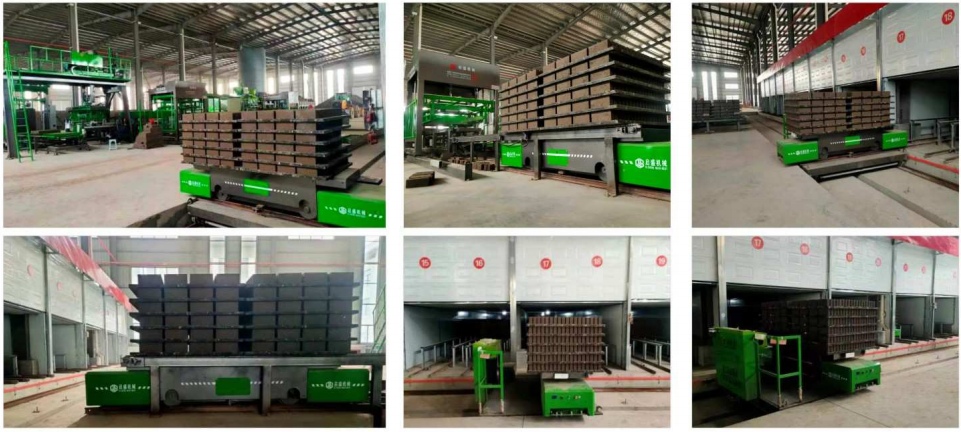
The QSRGV mother–daughter vehicle intelligent curing production line is an upgraded, fully automated intelligent curing system based on the traditional chain-type shuttle car production line. It boasts multiple national patents and can seamlessly switch between single- and multi-layer curing modes, maximizing the efficient use of curing space. It is a core piece of equipment for achieving unmanned, intelligent production in the brick-making industry.
This system employs a dual-power drive scheme. In rail-powered mode, 380V AC is converted into 36V safe DC via a specially designed transformer, providing a stable and secure power supply for equipment operation. In lithium-battery-powered mode, a 36V battery pack supplies power to the daughter vehicles, paired with a BMS battery management system that enables automatic charging and safety protection, ensuring full controllability throughout the entire operation process. Each daughter vehicle is equipped with an encoder that accurately calculates travel distance in real time, achieving millimeter-level positioning precision. One mother vehicle can be matched with multiple daughter vehicles, communicating via networked signals for real-time coordination, enabling cluster scheduling and collaborative operations to ensure precise positioning at every curing station and stable transfer of brick stacks.
The entire system is fully controlled by PLC plus a touch screen, allowing real-time monitoring of equipment operating status. Combined with light sensors and smart sensors, it achieves unmanned, automated operation. When a fault occurs, the system automatically shuts down, issues an alarm, and displays the fault location, eliminating the need for on-site troubleshooting by specialized technicians. Paired with a remote control system and cloud-based data transmission, managers can monitor the entire production line’s operating status from their offices, enabling remote maintenance and fault resolution, significantly reducing reliance on manual labor and lowering operational costs.
This production line is compatible with any model of block-forming machine, ensuring seamless integration between new and existing equipment, and can also be customized according to customer site conditions and production capacity requirements. After adopting this fully automated production line, only 3–4 workers are needed to complete all production tasks. Compared to traditional curing lines, it not only greatly improves work efficiency but also significantly reduces worker fatigue and labor costs, making it the preferred solution for large-scale brick manufacturers seeking to upgrade capacity and achieve intelligent transformation.
Core Configuration Table
Serial No. | Name | Description of Component |
|---|---|---|
1 | Brick Stack Conveyor | Installed in front of the stacking machine and the palletizing lift, used to hold brick stacks transported by the daughter vehicles. |
2 | Transport Daughter Vehicle | Powered by DC and controlled wirelessly, used to transport brick stacks to designated locations. |
3 | Shuttle Mother Vehicle | Used to precisely shuttle the transport daughter vehicles to specified positions. |
4 | Rail Insulation Adjustment Bracket | Specially designed for rail-powered systems, used to insulate the rails from the ground and adjust rail height. |
5 | Smart Charging Station | Specifically designed for new-energy batteries, used to charge the transport vehicles. |
6 | Automatic Control System | Utilizes PLC and a touch screen, working with various sensors to automate the entire production line, complemented by a wireless internet-based remote control system. |
7 | Automatic Palletizing System | Depending on the machine model and customer needs, it can be paired with any type of automatic palletizing system. |
8 | Return Plate System | Used to convey empty pallets to the automatic loading machine. |
Core Advantages and Technical Features
Feature | Description |
|---|---|
Dual-Power Drive | Offers two power modes—rail-powered or lithium-battery powered—adapting to different plant power supply conditions while ensuring safety and stability. |
Cluster Scheduling | One mother vehicle can coordinate with multiple daughter vehicles to efficiently complete brick stack transportation tasks. |
Precise Positioning | Encoders combined with networked communication enable millimeter-level positioning, ensuring error-free brick stack transfer. |
Intelligent Maintenance | PLC-based full automation, remote monitoring, and automatic fault alarms enable unmanned operation. |
Space Utilization | Supports both single- and multi-layer curing, maximizing the use of kiln space and improving site utilization. |
Flexible Compatibility | Seamlessly integrates with any model of block-forming machine and palletizing system, supporting upgrades of both old and new lines. |
Precise Target Customer Groups
1. Large and medium-sized brick manufacturers pursuing high-end, intelligent, unmanned production;
2. Newly established smart building materials industrial parks and high-standard unmanned brick production bases;
3. Manufacturers upgrading outdated equipment on traditional chain-type shuttle car curing lines;
4. Building materials companies with limited factory space who wish to improve curing space utilization and expand production capacity;
5. Boutique brick factories that prioritize production safety, low maintenance costs, and refined intelligent management.
Core Application Scenarios
High-end intelligent unmanned brick production line with three-dimensional curing operations;
Intelligent, unmanned upgrade of traditional chain-type shuttle car curing lines;
Multi-layer, three-dimensional, intensive curing of brick blanks in facilities with limited space;
Standardized batch curing of large-scale concrete blocks and unburnt bricks;
Complete配套curing systems for newly built high-standard smart building materials bases;
Modern brick factories requiring remote intelligent maintenance and unmanned operation.
Industry Core Pain Points
Heavy reliance on manual labor in traditional curing: addressing the pain points of heavy labor involved in manually transferring and storing brick stacks, excessive staffing needs, difficulty recruiting workers, and persistently high labor costs;
Waste of flat curing space: overcoming the problem of low space utilization in traditional single-layer flat curing, large land footprint, and the necessity of expanding factory buildings to increase capacity, resulting in wasted site resources;
Large positioning deviations in older equipment: improving the issue of inaccurate alignment, brick stack displacement, breakage due to collisions, and non-standard curing positions in traditional shuttle cars, leading to inconsistent product quality;
Complicated and cumbersome equipment maintenance: resolving difficulties in troubleshooting aging equipment, dependence on skilled technicians, inability to remotely monitor, long downtime, and impact on continuous production;
Poor compatibility of old production lines: breaking through the bottleneck of traditional curing equipment being unable to adapt to new and old equipment connections, high technical modification difficulty, high renovation costs, and gaps in intelligent production;
Prominent production safety hazards: addressing risks such as electrical leakage and collisions arising from traditional high-voltage power supply and close-range manual operations, thus realizing safe, unmanned production.
Core Production Value
Extreme labor savings and significant reduction in labor costs: With highly automated, unmanned intelligent operation across the entire line, only 3–4 workers are needed to handle all production tasks, drastically cutting down on staffing compared to traditional curing lines, thereby reducing salary, training, and management expenses.
Intensive land use and improved space utilization: Supporting free switching between single- and multi-layer three-dimensional curing, maximizing kiln space utilization without needing to expand factory buildings, thus increasing production capacity and saving on site occupation and infrastructure investment.
Precise curing and stable product quality: Millimeter-level precise positioning, standardized workstation curing, uniform stress and temperature/humidity conditions for brick blanks, resulting in consistent strength and neat appearance, significantly reducing defect rates and losses.
Intelligent maintenance and reduced downtime losses: Automatic fault alarms, precise positioning, and cloud-based remote maintenance eliminate the need for dedicated on-site personnel to troubleshoot, keeping equipment failure rates low and utilization rates high, ensuring 24-hour continuous, stable mass production.
Flexible adaptation and low barriers to technical modification: Compatible with both new and old brick-making equipment, adaptable to various production line modifications, customizable solutions available, quick implementation, strong adaptability, and rapid completion of factory intelligent upgrades.
Safe compliance and standardized production: Powered by 36V safe low voltage and double-layer lithium-battery safety guarantees, unmanned operation avoids human safety risks, standardizes production processes, and meets the standards of high-end factories and international trade supply.
Common Questions FAQ
Q1: What are the advantages of the QSRGV mother–daughter vehicle curing line compared to traditional shuttle car production lines?
A: This is a patented, upgraded intelligent curing system that supports dual-power supply, cluster scheduling, millimeter-level precise positioning, and cloud-based remote maintenance. It enables multi-layer three-dimensional curing, with levels of unmanned operation, space utilization, and stability far surpassing those of traditional chain-type shuttle car equipment.
Q2: Can this equipment be adapted for upgrading older brick production lines?
A: Extremely compatible—it seamlessly interfaces with any model of block-forming machine and palletizing system, perfectly suited for upgrading old lines and supporting new line configurations, with options for customized solutions.
Q3: How many power supply modes does this equipment offer, and how safe are they?
A: It supports both rail-powered 36V safe DC and lithium-battery dual-mode power supply, paired with a BMS battery management system and fault-protection shutdown features, ensuring full safety and controllability throughout operation, with no electrical safety hazards.
Q4: Is the entire line highly automated, and how much manpower is required?
A: Fully automated unmanned transfer, curing, and cyclical operations; only 3–4 workers are needed to oversee the entire production process, greatly reducing reliance on manual labor.
Q5: Does this equipment support remote monitoring and fault maintenance?
A: Equipped with cloud-based data transmission and a remote control system, it allows real-time viewing of the entire line’s operating status, remote troubleshooting, and maintenance adjustments, significantly easing after-sales service and operational complexity.
Note: The above configurations and features represent standard solutions, which can be individually customized according to customers’ specific brick types, site conditions, and production capacity requirements.
Related Products


Hot Articles
- QSRGV Intelligent Maintenance Production Line for Mother-and-Child Vehicles
- QSGW Intelligent High-Position Fully Automatic Production Line
- QSDJ Intelligent Belt-Frame Curing Fully Automatic Production Line
- QST8-15 Fully Automatic Block Molding Machine
- QST1200 Fully Automatic Concrete Block Molding Machine
 Home
Home Tel Consultation
 TOP
TOP